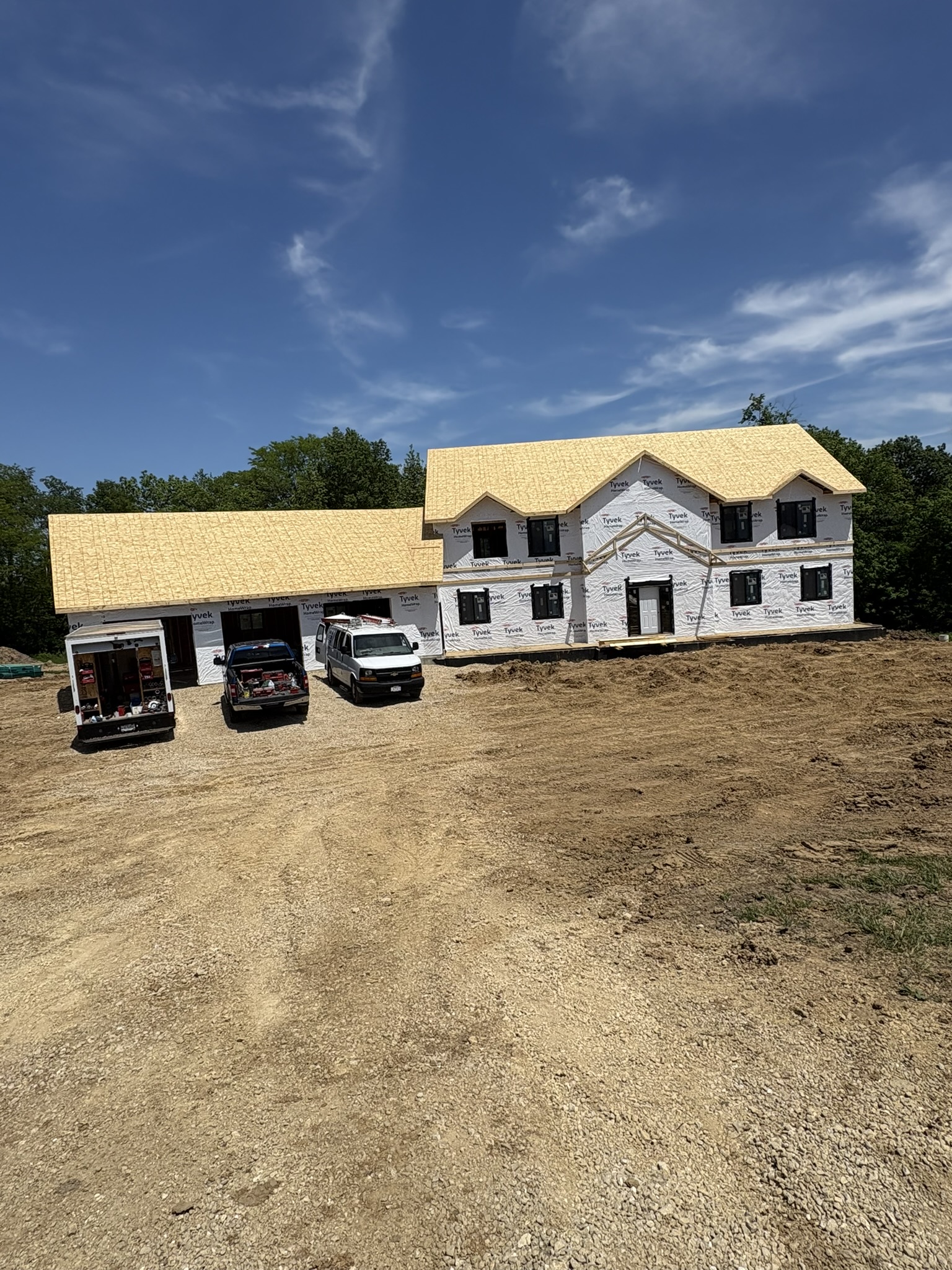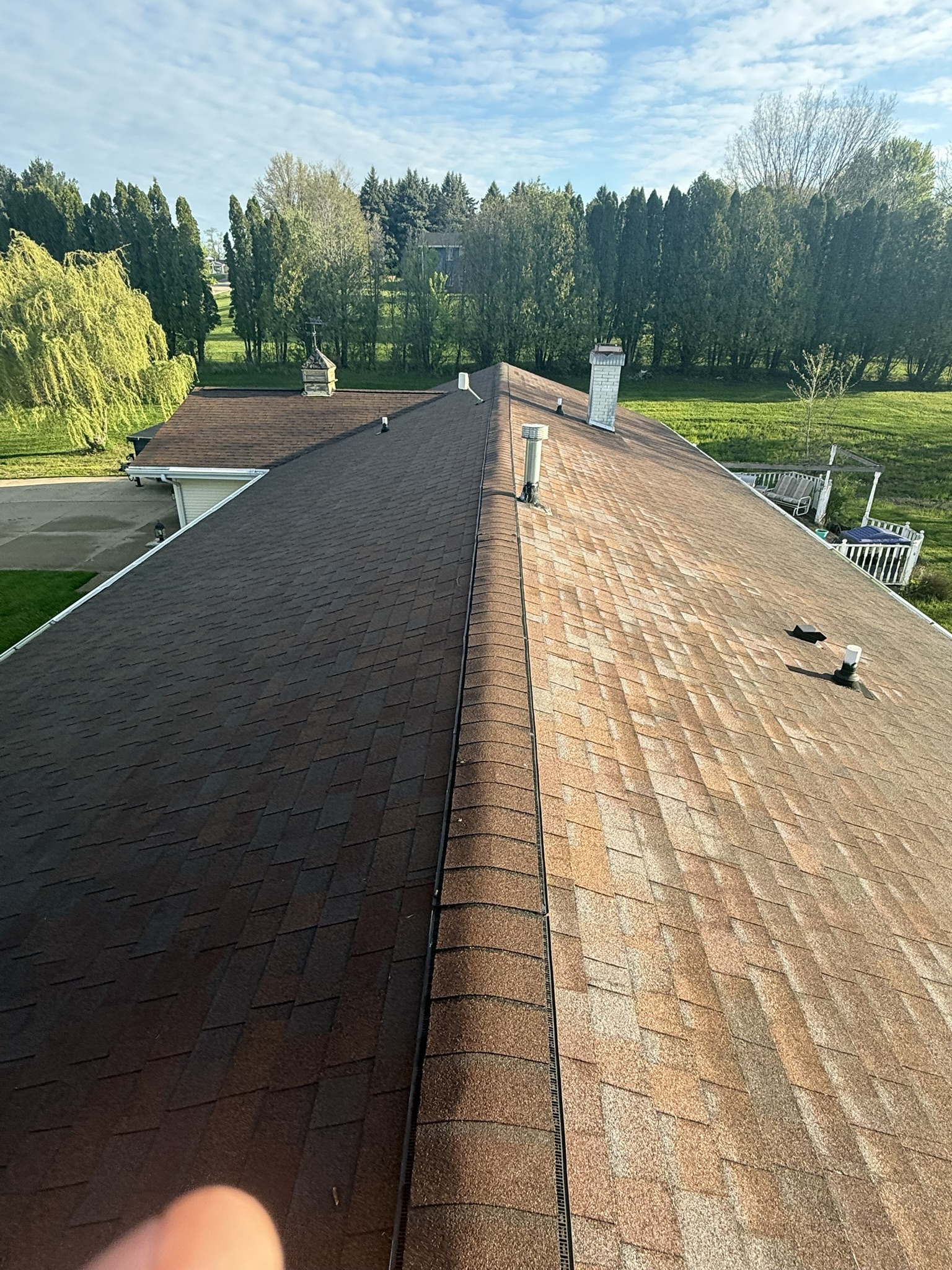
What an acreage roof actually deals with.
A house on five or ten acres west of town has nothing standing between it and the weather. No neighboring rooflines breaking up a gust, no mature block of trees slowing anything down. Wind arrives at the eave edge at full speed and works at the perimeter courses first, which is why the shingles that go missing on an acreage almost always go from the same corner every time.
Collin spent eleven years running post-frame builds for a contractor here in eastern Iowa before he started NXT Build in 2024, so the shop roof behind the house is not unfamiliar territory. It is the work he came up in. The full range of what we install is laid out on our roofing page.
Winter, then hail, then whatever spring brings.
Two seasons do most of the damage to a roof around Peosta, and they do it in completely different ways. Winter is patient. Snow sits, warm air escaping from an under-insulated attic melts the layer touching the deck, that water travels down to the cold overhang past the heated space, and it freezes there. Do that thirty or forty times between December and March and water finds its way backward under the shingle courses until a ceiling stain shows up in a bedroom.
Spring is the opposite. It shows up in one afternoon. Hail comes across open ground with nothing to break it, bruises the mat under the granules, and knocks the surface off soft spots you cannot see from the driveway. The roof does not leak that week. It leaks two or three years later once those bruises open up under the sun. That gap between the storm and the symptom is why we would rather look at a roof right after a hail event than after you notice a stain.

Tearing off versus laying over what is there.
People ask about going over the top of the old shingles because it sounds like the cheaper path, and on paper for a day or two it is. What it buys you is a second layer of weight on a structure sized for one, and a permanent guarantee that nobody looks at the wood underneath. Every problem the old roof was hiding stays hidden, and now it is hidden under something new that you paid for.
We strip it. That is the standard answer here unless there is a reason to do otherwise, and if there is one we will say so. Stripping is what lets us stand on bare wood and find the soft sheet beside a vent, the spot beneath a valley where water has been quietly working, the plank spacing on an older place that will not hold a fastener properly anymore. None of that can be quoted from the ground, and none of it should be a surprise you hear about after the fact.
The decking and vents we find underneath.
Two things turn up on a bare deck often enough that we expect them. The first is sheathing that has lost its bite. Around a vent pipe, behind a chimney, at the low end of a valley, wood that has been damp on and off for years goes punky and will not hold a nail at the value it is supposed to. Fastening new shingles to it is a waste of the shingles.
The second one is airflow, and it is the one that matters far past this roof. Plenty of the attics we open up have exhaust at the ridge and almost nothing pulling in at the soffit, so the vent at the top just sits there with nothing feeding it. That attic stays warm all winter, which is exactly the condition that builds ice at your overhang, and it bakes in July, which shortens the life of whatever you just put down. Fixing the intake side is not expensive and nobody sells it to you.
We handle it while the deck is open, run self-adhering membrane at the eaves and up through the valleys past the wall line, put synthetic over the rest of the field, and flash every penetration properly. Then the shingles go on. See finished work in the gallery, or get in touch and we will come look at yours.
Steel on the shop, shingles on the house.
Most Peosta properties end up wanting both, and that is fine because the answer is genuinely different for each building. On a post-frame storage building, steel is what belongs up there. It sheds snow, it goes over purlins the way the building was designed for, and it will outlive several asphalt roofs. Whether that steel is standing seam with its fasteners tucked out of the weather or a ribbed panel screwed through the face comes down to the building. A heated shop you plan to keep for thirty years earns the concealed system. A cold storage building does not, and we will tell you that instead of upselling it.
On the house, architectural asphalt is usually the right call and we say so without apology. It suits the rooflines out here, it performs, and the money saved against a steel roof is real. Steel on a home is worth the conversation if you plan to stay a long while, and it is a conversation we are happy to have with actual numbers instead of a brochure. We roof the post-frame buildings we put up and the barndominiums we finish out, and we tie new roof into old on additions and on new homes alike.
Nails in the drive, and how we leave it.
On an acreage the ground around the house is the ground you use. It is where the truck parks, where the dog runs, where the kids walk barefoot to the shop in July. A tear-off throws thousands of old fasteners off the roof, and a crew that treats cleanup as an afterthought leaves them in the gravel for you to find with a tire.
We tarp before anything comes off, keep the debris landing where we put it rather than in the beds and the lawn, and run a magnet over the drive and the perimeter at the end of every day rather than only on the last one. Then Collin walks the property with you before we pull out. The way your place looks when we leave is part of the job, not a favor. Cleaning up after ourselves was one of the things he wanted done better when he started this company, along with tighter schedules and straight answers about what things cost and how long they take.
Peosta, IA
Ten minutes west of Dubuque on Highway 20, and inside our regular working range from the shop at Zwingle.